Candy Land: A Short History of a Sweet Little Game

Doug Larson
OCC Editor in Chief

This is Candy Land!
Candy Land was invented in 1948 by a woman named Eleanor Abbott while she was recovering from polio. Eleanor was a retired school teacher, and came up with the game as a way to help the children who shared her ward pass the time until recovery. Her goal was to make a game so simple that any child could play. Candy Land requires no reading and only a small amount of counting, so any child who can recognize colors and follow simple instructions can enjoy the game.

The Original Magical Adventure
Eleanor’s original theme was built around guiding the children through a magical land made of candy with the goal of reaching their home at the end of the journey. The only action required to play was to draw cards and move player pieces to the corresponding color on the card. This made the game easy to play even for hospital patients with low energy. As the children made their way around through Candy Land, they could encounter shortcuts and setbacks which added extra variety to the otherwise simple gameplay. Though the gameplay is extraordinarily simple, relying on the luck of the drawn cards to advance; the young target audience has always found it to be riveting.
Candy Land remained largely unchanged from 1949 to 1978 save for occasional updates to the board art, and a reduction in game spaces from 179 spaces to 134 spaces in 1962. In 1984 Hasbro purchased Milton Bradley and introduced a redesigned version of Candy Land that not only added new non-player characters, but a storyline and lore to the game as well. Since the original inspiration for the game’s creation, the polio epidemic, had become less of a concern to modern audiences, the focus of the game shifted to grand adventure.

A New Adventure With New Friends!
In the 1984 edition of Candy Land, the denizens of the aforementioned mythical world are distraught due to the sudden loss of their king and his castle. The good King Kandy and his castle have mysteriously disappeared, and the residents of Candy Land are powerless to find him. The kind old Gramma Nutt advises Queen Frostine and Princess Lolly to place their trust in the mysterious new children who recently appeared in Candy Land. The children can take control of little gingerbread man helpers to navigate the magical world of Candy Land and search for King Kandy and his missing castle.
The children must beware that not everyone in Candy Land wishes to help them along their way. Plumpy, the benign occupant of the gingerbread sugar plum forest has no worries for the future of Candy Land. He spends his days eating gingerbread sugar plums and growing round. Should the children ask for his help, he’s likely to keep them as guests in the sugar plum forest longer than they may wish… Lord Licorice is the most sinister of Candy Land’s creatures, and is not at all to be trusted. It’s been whispered throughout the land that he may be behind King Kandy’s disappearance!
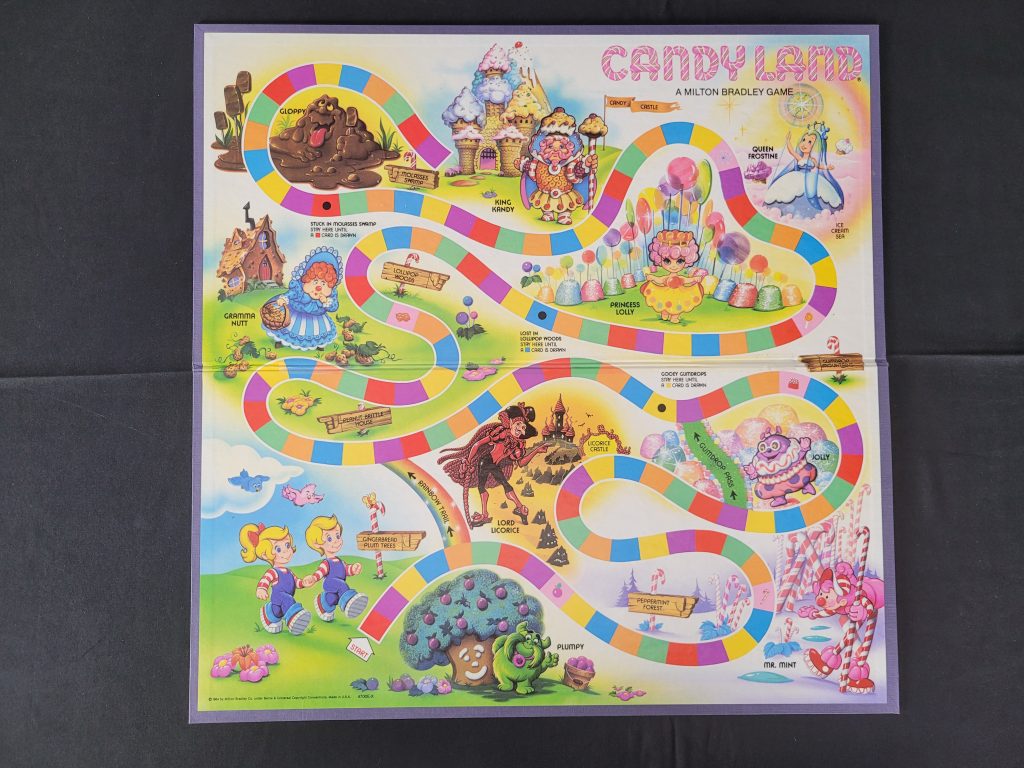
Old Game, New Art
Since their introduction in 1984, the characters in Candy Land have gone through a number of changes. Queen Frostine and Princess Lolli lost and regained their royal titles, Gramma Nutt became Nanna Nutt, and Plumpy was removed altogether! In more recent years, the game board has also seen dramatic artistic changes; the most controversial being in 2013.
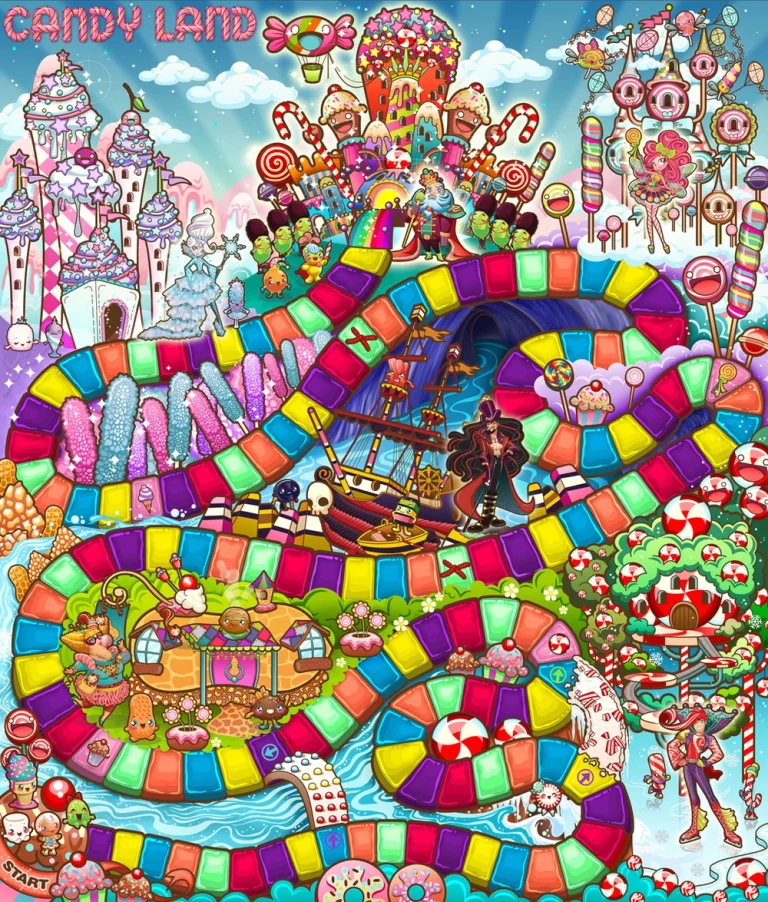
The 2013 board art was so poorly received that it was replaced the very next year. Despite all of these changes, the gameplay has remained largely the same throughout all of the versions. It seems unlikely that the lore Hasbro has worked so hard to introduce into the game will take root with fans on any meaningful level, which is unfortunate. If only they had evolved the characters and story instead of replacing and re-working their world with such frequency, they may have succeeded in establishing a classic franchise.
Regardless of my feelings for Hasbro’s interpretations of the classic game, I cannot deny my warm regards for Candy Land. Eleanor Abbott continued to use funds she earned from the game throughout her life to pay for school equipment and improve the futures of many youngsters. It’s hard to have anything but affection for a game that was created out of pure love and empathy for children in need of happiness; by a person who continued to demonstrate those qualities for the remainder of their life.
Check out my Candy Land Retro Board Game Reveiw on YouTube
Get your copy of Candy Land