Cherry Picking History & The Woman Behind Hi-Ho Cherry-O

Doug Larson
OCC Editor in Chief

Board games are such a part of our culture today that it’s hard to imagine a world without them. You may have a weekly game night with your friends, or only decide to dust off your copy of Clue on a rainy day, but it’s a sure bet that there’s a board game somewhere in your home. Board games offer a way to bond with friends and family, to test our skills, and of course, to educate. Using board games as a teaching aid is not a new phenomenon. Milton Bradley famously created his Checkered Game of Life in 1860 to teach players lessons about morality. Elizabeth “Lizzy” Magie invented the Landlord’s Game, a precursor to Monopoly, in 1903 to teach players about the dangers of land ownership monopolies.
By combining learning with play, educators are better able to reach students on their level and make a lasting impression.
In the case of Hi-Ho Cherry-O, young players are treated to a bright and colorful game about filling their baskets with delicious freshly picked cherries while avoiding spills and hungry animals who want to steal them. The educational value rests in the player’s ability to add and subtract cherries from their basket as instructed by the game’s signature spinner. With each spin, players will be either instructed to pick a select amount of cherries, or return them to the tree as they are lost. The first player to collect all ten cherries from their tree is the winner.

This simple game was originally published by Whitman Publishing in 1960 and has since become an educational staple in many board game collections. For over 65 years Hi-Ho Cherry-O has delighted children and is still currently produced by Hasbro. Though Hasbro has never publicly disclosed sales figures for Hi-Ho Cherry-O, it’s pretty obvious that a board game doesn’t continue to sell for over half a century without being a resounding success. Credit where credit is due, as the saying goes. And in the spirit of that saying, it’s time for me to share another chapter in the history of Hi-Ho Cherry-O that is much lesser known.

A small YouTube board gaming channel stumbles into a big story.
The niche videos that I make are dedicated to classic board games and toys. I never set out to be a historian, but as my videos began to draw a following, the demand for context and history behind the games I was reviewing grew. Of course I began to spend more time researching the sometimes wild and unlikely origins of my favorite games. It became a never ending rabbit hole of copyright disputes, shady dealings, and modern miracles. Games that were unremarkable at first glance often hid amazingly unexpected origin stories, and Hi-Ho Cherry-O is such a game.
I published a video review of Hi-Ho Cherry-O in 2025 in which I compared the original version as produced by Whitman Publishing to the modern edition by Hasbro. For me, it was an unremarkable review of a game with such a bland history that I resorted to a short skit partway through the video to voice my displeasure with the modern version of the game. As usual, my regular viewers enjoyed the brief trip down memory lane and we all moved on to look at more exciting games.
So far as I was concerned, that’s all there was to know about Hi-Ho Cherry-O.
Months later, I received an interesting email about my video. It’s not uncommon for me to receive feedback about my work, but this time it was different. A woman named Linda Landfried Buss had written me a spirited letter asserting that her mother, Lorraine Landfried, was the real inventor of the Hi-Ho Cherry-O, and had gone uncredited for all these years. She backed up this claim with personal information about Lorraine, and the promise that she had paperwork to prove it.
Linda explained that she was tired of seeing two Whitman Publishing employees, designer Hermann Wernhard and artist Katrin Lindley, receive credit for her mother’s creation. She went on to explain that Lorraine had invented the game “Let’s Pick Cherries” some time in the late 1950s while pursuing her career as an elementary school teacher. Her inspiration for the game came from her roots in Door County Wisconsin, where she and her children would gather cherries in the summertime. Lorraine had sold the game to Whitman Publishing (a division of Western Publishing) in 1959 for $400 (roughly $4,300 today) and received twelve copies of Hi-Ho Cherry-O as part of the agreement.

This modus operandi was hardly out of the ordinary for the board gaming industry at the time.
Another famous example of such a deal is the one struck between the inventor of Operation, John Spinello, and Marvin Glass & Associates in 1964. In that instance Spinello was an industrial-design student who sold his prototype and idea for $500 and the promise of a job which he never received after graduation. After decades of going unrecognized for his work, Spinello eventually had to resort to crowd funding to afford his own surgery in 2014, which finally launched him into the pop culture spotlight.
Linda went on to tell me that she had tried to contact the current producer of the game, Hasbro Gaming, for some manner of recognition of Lorraine’s work but never received any response. I understood her frustration as I had also previously reached out to Hasbro for information about board game history and had likewise been ignored. You might be surprised to find out how tricky it can be researching classic board games. Sidelining game designers and artists in favor of promoting the publisher’s brand in association with a game has been common practice in the board gaming industry for many years. Unfortunately this practice has resulted in countless inventors and creatives going unsung.
While many early contracts like this were easily lost to time, the Landfrieds’ tenacity for record keeping ensured that Lorraine’s story won’t be. Linda was kind enough to provide a copy of the contract her parents signed with Whitman Publishing for Let’s Pick Cherries. 1959 was a different time, and you’ll notice that Lorraine’s full name does not even appear on the contract. At the time it was common for the head of the household, in this instance Lorraine’s husband Erling Landfried, to be named on legal documents in lieu of their spouse. This was not by any means a legal requirement. Women had been able to sign their own contracts for a long time at this point, but social norms were yet to catch up.

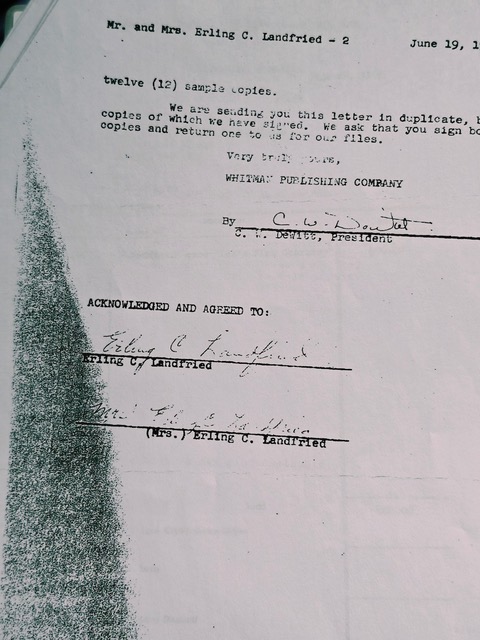
Lorraine is acknowledged as “Mrs. Erling Landfried” on the agreement. Even when selling her idea, she didn’t receive the recognition that she deserved.

This lack of recognition never slowed Lorraine down. After selling her game to Whitman Publishing in 1959, she went on to earn her bachelor of science degree in 1962 from Wayne State University in Detroit, and continued her graduate work at Wisconsin State University, Michigan State University, Kent State University and John Carroll University. She raised five children, Linda, Dinah, Todd, Tracey, and Steve all while working as an elementary school teacher until her retirement in 1985. After retirement she served as a Telecare volunteer for Emergency Medical Services, wrote poetry, and enjoyed bible studies.
Lorraine passed away in 2012 and is survived not only by her children, grandchildren, and great grandchildren, but by the legacy that she left behind for countless other kids in the form of a simple game about picking cherries.
See the video here: The Untold Origin of Hi-Ho Cherry-O