Board Game Evolution: From Scrabble to Pictionary

Doug Larson
OCC Editor in Chief

I’ve reviewed a lot of classic games, mostly comparing vintage to modern to see how they’ve evolved over the years; but what happens when a game evolves into something completely different than what it started out as? This is the story of how Scrabble became Pictionary!
It all started back in 1931, Alfred Butts was hard at work refining a word game he had created called Lexico. He had studied the frequency with which letters were used in common print periodicals and determined a point value to match. He called his new variation of the game Criss-Crosswords. Unfortunately, he was unsuccessful at marketing the game and sold the rights to James Brunot in 1948.

Brunot made a number of changes to the game’s formula and dubbed it Scrabble. In 1949 he and his family personally produced 2400 copies of the game, all of which sold at a loss. The game almost disappeared forever, but Jack Straus, chairman of Macy’s department stores, discovered the game by chance while on vacation. Delighted by Scrabble, he placed a massive order to stock in his department store and saved the brand. Once Scrabble began appearing in Macy’s department stores, sales skyrocketed. By 1952 demand outpaced production and Brunot licensed Scrabble to Selchow and Righter for production. Since then, Scrabble has become a household name.
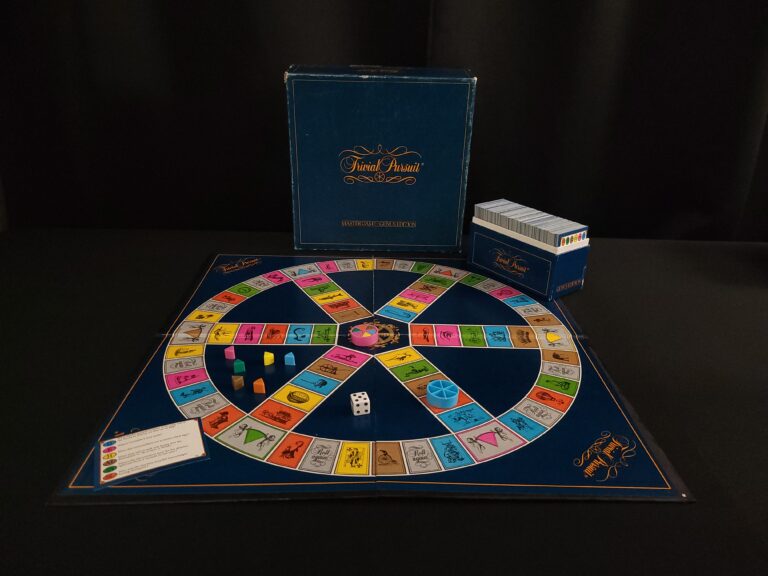
Thirty years later in 1979, two Canadians named Chris Haney and Scott Abbott were purportedly playing a game of Scrabble, which was missing tiles, and inspired them to create their own game. Within minutes they drew their first prototype on the back of a cigarette carton, and Trivial Pursuit was born! The two spent the following year researching and testing trivia questions for the game which was finally published in 1981. By 1982, 100,000 copies had been sold, which led to Trivial Pursuit’s 1983 release in the U.S. Though Trivial Pursuit saw a meteoric rise, it was almost toppled by a $300,000,000 lawsuit leveled against its creators and publisher in 1982.

Fred Worth, author of The Complete Unabridged Super Trivia Encyclopedia discovered that over 20% of the questions featured in Trivial Pursuit Genus, Silver Screen, and Baby Boomer editions were taken directly from two of his trivia books. Worth discovered the use of his work by planting a clever inaccuracy amongst his facts, lovingly known as the “Columbo trap.” In his book he asks “What is detective Columbo’s first name?” referring to a popular 1970’s television series starring Peter Falk. The supposed correct answer is “Philip” however, fans of the hit TV series will recall that Columbo’s first name is never revealed at any time in the show.

Trivial Pursuit and its publisher Selchow and Righter prevailed in the lawsuit when the United States 9th Circuit Court of Appeals ruled that facts cannot be copyrighted, even if they were made up. This was a landmark ruling that determined the expression and use of the material, though similar, did not constitute copyright infringement and the “brow sweat” involved in aggregating the facts did not qualify for copyright protection. In effect, this ruling saved Trivial Pursuit.

To date, more than 100 million copies of Trivial Pursuit have been sold; but it only took one copy, all the way back in 1981, to inspire Robert Angel to create another iconic board game, Pictionary! Though he was inspired by Trivial Pursuit and conceived the idea for Pictionary in 1981, his game wouldn’t see release until he self published in 1985. Angel and his close friends pooled $35,000 to have 1,000 copies of the game printed. The games eventually needed to be sorted and packed before sale in Robert’s own apartment because the printing company was unable to sort the 500,000 cards for the game into individual sets. With one week before launch, Angel and his friends raced to sort and pack the cards in time. To accomplish this feat, Angel moved all of his furniture out of his living room to construct an “assembly line” of tables in his 900 square foot apartment.

The game was a success, and by the end of the year the team had sold more than 6,000 copies. In 1986 Angel Games licensed Pictionary to The Games Gang and Western Publishing, and by the end of 1987 over 3 million copies of Pictionary had been sold. Pictionary is currently produced by Mattel, and to date it is estimated to have sold over 32 Million copies in the United States alone.
What a fascinating tale of how three games, all of which almost didn’t succeed, managed to inspire each other, and etch their names into pop culture history!
Video: Weird Board Game Evolution!
See my video review of The Worst Case Scenario Survival Game.