Mouse Trap Retro Board Game Review

Doug Larson
OCC Editor in Chief

This is Mouse Trap!
Mouse Trap was originally published by Ideal in 1963, and is widely considered to be one of the most popular 3D board games. The creation of the game was a combined effort between two companies. The premise of the game was conceptualized by Marvin Glass and Gordon Barlow of Marvin Glass & Associates, while the game itself was designed by Hank Kramer of Ideal Toy Co. Modern versions of the Mouse Trap are now produced and sold by Hasbro Games. Today we are going to compare the iconic Milton Bradley edition from 1986 to the modernized Hasbro edition from 2021. Let’s see what has changed over 35 years!
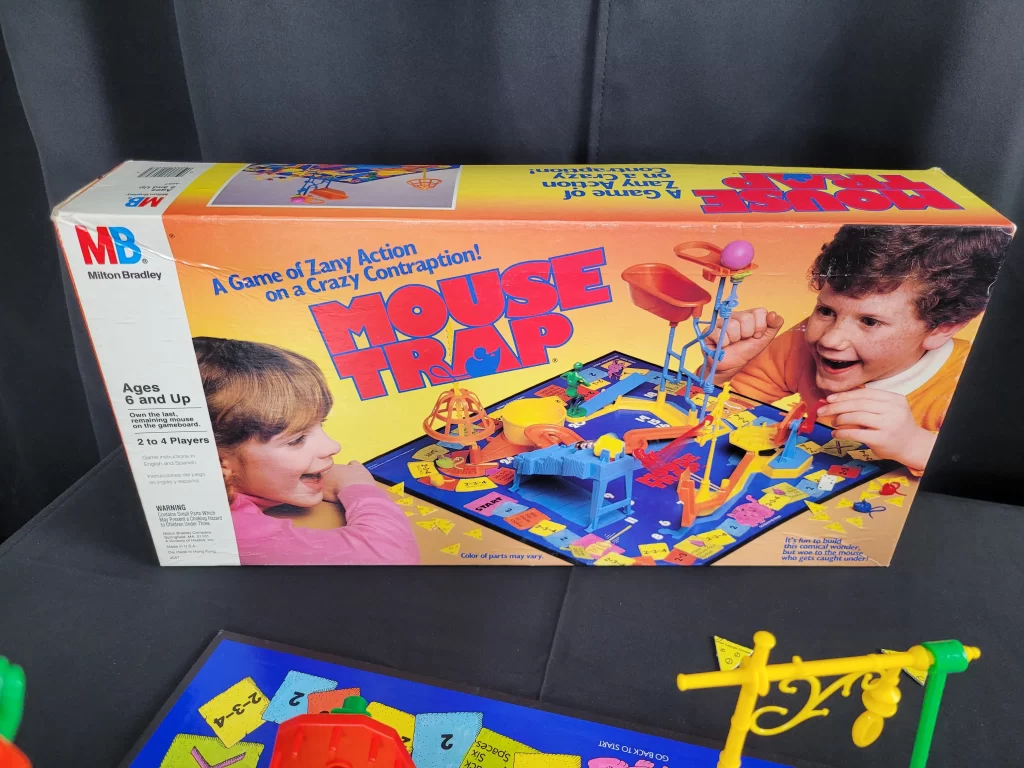
Box Art
The first thing I notice when comparing any game is the box art, so that’s where we can begin. The 1986 edition from Milton Bradley features the classic white band across the side of the box where information was listed such as the game’s intended age range, intended number of players, and usually a brief description of the game’s core mechanic. This was common amongst Milton Bradley games of the era, and in my opinion a great branding move. This made shopping for an appropriate game easy for the discerning consumer.
Beyond the boring details, the vibrant colors on the front of the box do an excellent job of capturing your attention. The red/orange background contrasts beautifully with the blue art featured on the game board. This contrast really makes the game pop nicely. The children on the front playing the game couldn’t look happier if they tried, and I don’t blame them!
The back of the box is relatively boring, and not worth much notation. Common macro shots of the game pieces abound. What is of note is the actual construction of the box itself. Mouse Trap is a game of many parts and pieces, and those pieces must be stored. The 1986 edition of the game by Milton Bradley features a two piece box constructed of sturdy tagboard that has proven to last over 30 years so far. The tight fitting design allows you to store the game and all of its parts safely as well.

Moving to the 2021 edition by Hasbro we can see a definite contrast in the art style. This box features a much more contemporary look. Four mice are featured on the front, each a color offered to players within the game. I enjoy the bright little mice, and they remind me of the art style found in a lot of modern Nickelodeon and Cartoon Network shows. When we flip the box over, we can see Hasbro has chosen to showcase some children having a great time with the game. There are also some more macro images of the game board and pieces. The art style is a little busier, but nothing out of the norm for a board game.
The structure of the box is my biggest sticking point. The 2021 Hasbro edition features a flip top box that is significantly smaller than the 1986 Milton Bradley edition. Though the 2021 edition’s board now folds into quarters, which takes up less space in the box, it still provides too little space for all of the game’s components to comfortably fit. It took me more time to try and wrestle the components of the game back into the box than to set the trap up to play. I’m disappointed because Hasbro provided an excellent box for the 2021 edition of Forbidden Bridge. Naturally, I’d have assumed Hasbro would have put the same care into one of their more well known IP’s like Mouse Trap.

Gameplay
Comparing gameplay, we’ll start with the 1986 edition. The board features spaces that are printed with either numbers or instructions. As players work their way around the board they will either assemble the trap as indicated by the numbered spaces, or perform an action such as collecting a piece of cheese. The numbered spaces refer to how the trap should be assembled based on the number of players. This is to pace the construction of the trap to match the speed at which players make their way around the board. For instance, if you were to land on certain spaces you would add a piece to the trap if there were two players in the game, but not if there were more, and so on.
Once players reach the end of the board, they enter what is called “the loop.” The loop consists of five normal spaces and one large space called “the cheese wheel.” The cheese wheel is the most dangerous spot on the board, as that is where the trap’s cage lands. Players will complete the game by circling the loop, spending their cheese to move opponents under the trap, and repeatedly setting off the trap in the hopes of eliminating their opponents. The last mouse left who hasn’t been trapped wins the game.

When we take a look at the 2021 edition of the game we immediately notice significant changes not only to the board art, but to the game map as well. Players are no longer presented with text instructions or numbered spaces. Now small icons on the spaces indicate whether a player should collect, lose, or steal a piece of cheese, as well as set off the trap. Gone is “the loop” in favor of a complete circuit that wraps around the periphery of the board and includes little colorful pipe shortcuts that bisect the map.
When it comes to keeping score in the 2021 edition, the cheese stands alone. The primary objective of the game is for players to collect six pieces of cheese to complete an entire wheel. The new game play maximizes the collection mechanic by ensuring that players have plenty of opportunities to collect, lose, and steal their way to victory. If a player is caught in the trap, they do not die, they simply lose two pieces of cheese. This keeps all players active right up until the end of the game.

The Trap
The mechanism for the trap has seen some updates between 1986 and 2021. The crank that triggered the trap in the 1986 edition has been removed, as well as a few other parts with such names as “the helping hands post” and “the thing-a-ma-jig.” These changes reduce small parts and add more kinetic action to the mechanism. Over all, the function of the trap is largely unchanged, and I do not feel that either edition has a particular advantage in this regard. Both are delightful to watch in action.
The Verdict
Now that all of the details have been compared, I feel that both the 1986 Milton Bradley edition, and the 2021 Hasbro edition of Mouse Trap have their unique gameplay qualities to offer. In the end, I think the 2021 Hasbro edition offers the most fun in the form of an updated rule set that encourages fast and exciting play. The simplicity of starting the game with a fully assembled trap is a boon as well. If you would like to see a video comparison of the two editions, check out my Mouse Trap Retro Board Game Review on YouTube.
Use this link to get your very own copy of the 2021 edition of Mouse Trap!